News
Adoption, community and finding a place to belong in rural Wales
14 September 2026
What does growing up in rural Wales offer a child?
Space to run. A school where everyone knows your name. Neighbours who turn up with food when you need it. A community that looks out for you.
But for adoptive families, living in a close-knit rural community can bring its own considerations too – from setting boundaries when a child first comes home to helping the people around you understand adoption and the experiences that may have shaped your child.
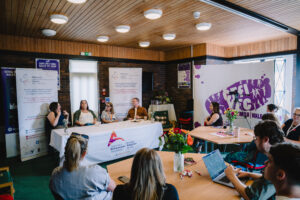
At this year’s Royal Welsh Show, the National Adoption Service for Wales brought together adopters and professionals to talk openly about just that: adoption in rural Wales.
Hosted by presenter Luke Davies, the conversation explored the realities of raising adopted children in agricultural communities – and challenged some of the assumptions about who can adopt and what an adoptive family should look like.
“Living on a farm is the best childhood you’ll ever have”
Carys, 32, adopted two children through Adoption Mid and West Wales, adopting for the first time when she was just 25.
For her, raising her children on the family farm has meant being able to share something that has been part of her own family for generations.
“Living on a farm is the best childhood you’ll ever have,” she said. “And it’s a privilege to know that I’m passing down my family’s generational heritage to my children through the farm.”
And then there are the neighbours.
“My next-door neighbours are sheep,” she joked.
But behind the joke is something Carys believes has been hugely important for her children: belonging to a community where people know one another.
“In a city, you may not know who your neighbour is, whereas here everyone knows each other.”
That sense of connection came through strongly throughout the Royal Welsh conversation.
One adoption professional reflected that the geography itself can be an asset for some children who have experienced adversity, providing space to move, regulate their emotions and recover from some of their earlier experiences.
It is, of course, not about suggesting that rural life is right for every child. Every child waiting for adoption has their own experiences, personality and needs.
But it does challenge the idea that living remotely or differently from a more traditional picture of family life is somehow a barrier to adoption.
A community that learns with you
Close communities can also mean that adoption is noticed.
Carys recalled people being unsure how to respond when her children joined her family.
“I’ve had someone say to me, ‘Do I say congratulations then?’, or people will avoid the topic because they don’t know what to say.”
Her response is refreshingly straightforward.
“I’m more than happy to have that chat with someone, it’s just education and awareness.”
For Annwyn, 38, who adopted siblings with her husband, bringing her children home also meant temporarily changing some of the unwritten rules of rural life.
“In a rural environment, we have an open-door policy,” she explained. “So, to stop people wandering in like they usually would, my husband and I had to set some boundaries straight away because our children needed time to settle in.”
The community respected those boundaries – without disappearing.
“People brought toys for the children,” Annwyn said. “And friends were dropping off food parcels in the middle of the night for us.”
It’s a lovely example of what support can sometimes look like.
Not necessarily knowing exactly what to say or do, but listening to a family, respecting what they need and showing up anyway.
Putting down roots
Today, Annwyn describes her children simply:
“My kids are thriving.”
“They love to run around the farm, which gives my husband and I a lovely warm feeling because we’ve sowed those seeds and given our children those roots.”
Those roots extend beyond home.
Both women spoke about their children’s experiences of attending small rural schools and the relationships they have been able to build with teachers.
“My kids go to a school with 36 children,” Annwyn said. “So, although the kids took a little time to settle, I was able to have a chat with their teacher and they’re more open to listen and learn about the children’s needs.”
Carys had experienced something similar.
“I feel like my children understand more, and they’re not just a number so their teachers really do know them.”
One small detail particularly stayed with her.
Her child is known at school by their first name followed by the name of their farm.
“It shows that they’re no different to other kids.”
For a conversation about adoption, it’s a deceptively powerful point.
Because ultimately, so much of what Carys and Annwyn described wasn’t about adoption at all.
It was about family, identity, community and belonging.
There is no one type of adoptive family
That was another message heard clearly at the Royal Welsh Show.
“We’ve worked with so many different families that all look so different, and they bring something so unique to those children,” one member of the panel reflected. “We really want to celebrate that. Families coming together through adoption is magic, really.”
Age is one of the things prospective adopters can worry about.
“People do think, ‘Oh, I’m older – there’s no way I can do it.’ But I think if you’re willing to do it, there’s a child out there that needs you to help them.”
And adoption doesn’t need to be something people consider only after every other possibility has been exhausted.
As another contribution to the conversation put it:
“Adoption shouldn’t be seen as a last resort. It should be an option from the start as well. It’s a choice.”
That feels particularly important.
There is no single route to becoming an adoptive parent – and no single picture of what an adoptive family looks like.
Parenting the child in front of you
There was honesty, too, about the fact that adoptive parenting can sometimes require looking beyond behaviour to understand what a child may be communicating.
Annwyn explained:
“We can relate to biological parents, but we do look at things differently. If a child is acting a certain way, we always ask the question, ‘is this a trauma response?’, where some parents may not.”
And Carys is wary of comparing her parenting with the picture presented online.
“I try not to look at it. Every child is different, so the way you parent them is, too.”
Perhaps that’s one of the simplest lessons from the whole conversation.
There isn’t a perfect adoptive parent.
There isn’t a perfect family.
And there isn’t one perfect place to raise a child.
What matters is being willing to understand the child who joins your family, to learn what they need and to build the support around them that helps them feel safe, connected and able to thrive.
For Carys, the way she describes what adoption has brought to her family says it better than we could:
“This is our happy ending and their exciting beginning.”
And when she and Annwyn were asked what they would say to someone who might be considering starting their own adoption journey, their answer was considerably shorter.
“Go for it.”